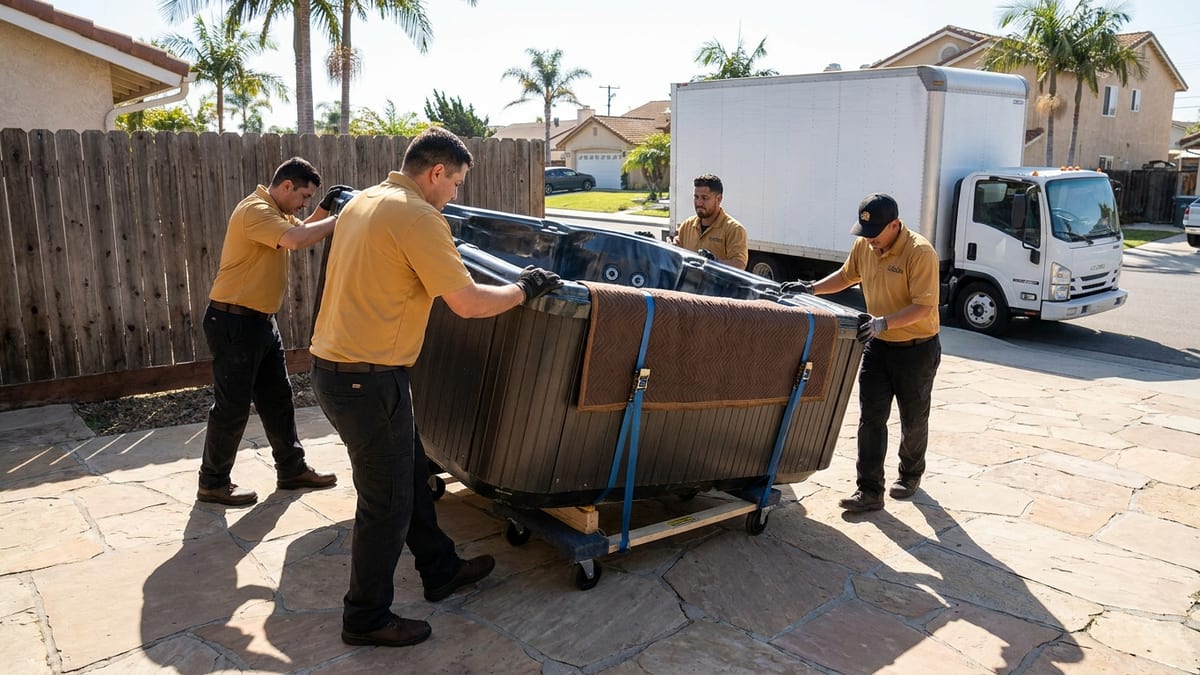
Most San Diego hot tub moves run $350-$800 when the spa sits at ground level with clear access for a four-person crew and dollies. Budget $1,000 or more when a crane is needed to clear a block wall, second-story deck, or canyon-lot backyard. A full spa weighs 700-1,000 lbs empty, and that weight is what drives every decision a mover makes before the job starts.
Why hot tubs take a dedicated crew and the right gear
A typical sofa weighs 200 lbs. A typical hot tub weighs four to five times that, and its weight is distributed in a wide, awkward shell that doesn’t grip well and can crack under uneven pressure. You need at least four people, heavy-duty appliance dollies, and moving straps rated for the load.
The shell is acrylic or fiberglass over a foam core. Both materials dent, crack, and scratch permanently if they’re set down wrong, dragged across concrete, or tipped at the wrong angle. The cabinet skirt is usually the most vulnerable part. Getting it from pad to truck without damage means keeping it level, moving slowly, and using padded dollies designed for the job.
This is different territory from moving a couch or a fridge. It’s closer to piano and specialty moving, where the object’s weight, fragility, and awkward shape require a team that’s done it before.
Dolly move vs crane lift: how access determines everything
The first question a hot tub mover asks isn’t about distance. It’s about access.
Dolly move: If there’s a clear path from the spa pad to the truck, at least 36 inches wide with no steps or steep slopes, a crew can roll the spa on appliance dollies. This is the less expensive scenario. The spa is tilted onto its side, slid onto a flat dolly, and walked out through a gate or along a driveway. Ground-level access with a direct path to the street is the ideal condition.
Crane lift: When the path is blocked, a crane or hydraulic lift is the only option. Common San Diego scenarios where this comes up: a hot tub installed in a walled-in backyard with no gate wide enough to pass the shell, a spa on a second-story deck, or a hillside property where the grade change between the spa pad and the street is more than a few feet. Crane rental alone typically runs $400-$600 for a half-day, and that cost gets passed through to the homeowner.
If you’re not sure which applies to your property, take a few photos of the spa location and the path to the street and send them to the moving company before you book. A good mover will tell you upfront whether it’s a dolly job or a crane job.
Draining and disconnecting the spa before moving day
The hot tub needs to be fully drained and disconnected from power before the crew arrives. A spa holds 400-500 gallons of water. At 8.3 lbs per gallon, a full tub weighs 3,000-4,000 lbs on top of the tub’s own weight. No crew moves that. It has to go.
Draining typically takes a few hours with the built-in drain and a garden hose extension. You can speed it up with a submersible pump. Once drained, tilt the tub slightly to let the last water run out of the jets and plumbing lines. Wet plumbing lines add weight and can drip through the move.
Disconnect the power at the breaker and cap the electrical connection. If your spa is hard-wired with a dedicated 220V circuit, you’ll need an electrician to disconnect it before the move and reconnect it at the destination. That’s a separate cost, typically $100-$200 each way, that’s not included in most moving quotes.
Access problems common in San Diego yards
San Diego’s older neighborhoods and hillside lots create a set of access challenges that come up on hot tub moves more than almost anywhere else.
Block walls and gated side yards: Homes in communities like Clairemont, Tierrasanta, and El Cajon often have 6-foot block walls with a single side-yard gate 30-36 inches wide. A hot tub shell is typically 7-8 feet on each side. It can’t pass through the gate. The only options are to remove a section of the block wall (homeowner’s responsibility), go over the wall with a crane, or confirm the tub can be stood on its end and walked through at an angle. That last option depends on ceiling height and path width.
Canyon-lot backyards in Scripps Ranch and Tierrasanta: These lots often have steep grade changes between the house and the street. A hot tub on a patio 15 feet below street level, with a hillside path in between, almost always requires a crane. The ground is too unstable and the slope too steep for a dolly crew to work safely.
Second-story decks: Rancho Bernardo, Santee, and parts of La Mesa have homes with hot tubs on elevated decks built over garages. The only way down is a crane or disassembly. Most hot tubs can’t be disassembled without destroying the shell.
Narrow side-yard passes: Even without a block wall, a side-yard passage with a 90-degree turn at the corner of the house can be a blocking point. The mover needs to be able to tilt and turn the tub through the corner without scraping the shell or the stucco.
What drives the cost of a hot tub move
Here’s a summary of the factors that move the price up or down:
| Scenario / access | Typical cost |
|---|---|
| Ground-level access, clear dolly path, within SD County | $350-$550 |
| Ground-level access with one or two turns, tight path | $500-$800 |
| Block wall or gate requires temporary panel removal | $600-$1,000 |
| Crane required (second story, hillside, walled yard) | $1,000-$1,800+ |
| Long-distance relocation (north county to south bay) | Add $150-$300 |
| Reinstallation and reconnect at destination | Quoted separately |
These are typical ranges. Your actual cost depends on crew size, distance, crane day rate, and job complexity. The only way to get a real number is to have a mover look at the access situation before booking.
Protecting the shell during the move
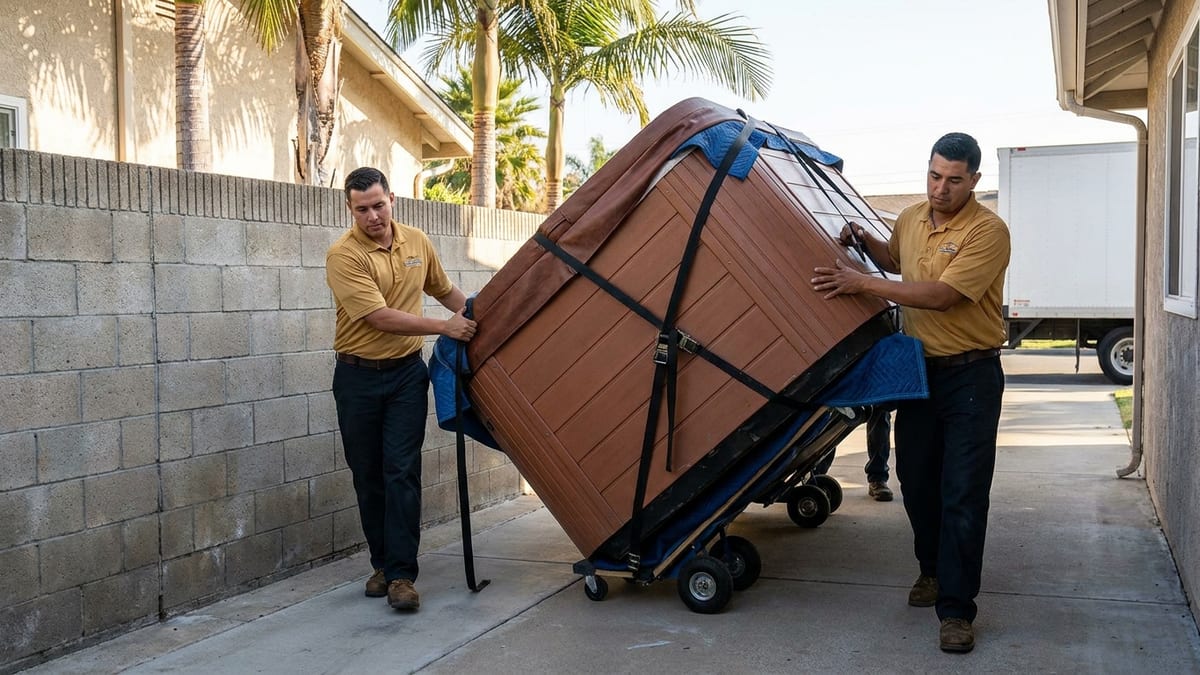
Acrylic shells scratch easily. Before the tub goes on a dolly, a good crew wraps the cabinet in moving blankets and secures them with stretch wrap. The corners and the top lip are the spots most likely to take a hit during transport.
On the truck, the tub gets strapped upright or on its side depending on its dimensions. Riding flat on its back is hard on the cabinet skirt and the equipment panel. Most crews keep the tub on its side with straps at two points.
At the destination, you’ll want the pad ready before the crew arrives. That means a level concrete or composite pad of the right size, the electrical circuit roughed in if it’s a new install, and the hose accessible for refilling. The move crew’s job ends when the tub is set on the pad. Reconnection is a separate trade.
This kind of careful handling is the same approach we bring to furniture moving and local moving for anything fragile or high-value. The principle is the same: slow down, plan the path, and don’t improvise when the stakes are high.
If you’ve ever thought about how similar the logistics are to relocating a piano, there’s a good reason for that. Check our guide on how to move a piano without damaging it or your floors for a sense of how specialty moving works in practice.
Getting an accurate quote
Most reputable hot tub movers in San Diego will want to see photos or do a site walkthrough before committing to a price. Be skeptical of any company that quotes a flat fee over the phone without asking about access. If the access turns out to be more complex than expected, you’ll either pay a surprise upcharge on moving day or the crew won’t have the right gear.
Call (858) 925-5546 and tell us about the spa location, the path to the street, and your destination. We’ll give you a binding estimate based on what the job actually involves.
Frequently asked questions
How much does it cost to move a hot tub in San Diego?
Most moves in San Diego County run $350-$800 for ground-level access with a standard dolly crew. When a crane is needed to clear a wall, deck, or hillside, expect $1,000-$1,800 or more. The exact number depends on access, distance, and whether the destination requires any special setup.
Do I need to drain the hot tub before the movers arrive?
Yes. A spa holds 400-500 gallons of water, which adds thousands of pounds to the load. Drain it fully, tilt it to clear the plumbing lines, and disconnect power at the breaker before the crew shows up. Moving a spa with water in it isn’t safe and most movers won’t attempt it.
Can a hot tub be moved through a standard gate?
Usually not. Most spa shells are 7-8 feet across, and standard side-yard gates run 30-36 inches wide. If there’s no wider opening in the fence or block wall, the options are to remove a fence panel, go over the wall with a crane, or stand the tub on end if the path and height allow it. Your mover should assess this before the job.
How many movers does it take to move a hot tub?
At minimum four people. On a straightforward dolly move, a crew of four can manage safely. For crane lifts or tight access situations, some jobs call for five or six. Trying to save money by using two or three movers on a 900-lb spa is how shells crack and people get hurt.
Does moving a hot tub require a crane?
Not always, but it’s common in San Diego. Properties with block-walled backyards, second-story decks, or hillside lots in neighborhoods like Tierrasanta, Scripps Ranch, and Rancho Bernardo frequently require one. The mover should confirm crane vs dolly during the site review, before any money changes hands.
Can you move a hot tub to a new house across San Diego County?
Yes. The same crew that handles the disconnect and load at the origin can deliver and set the tub at the destination. Long-distance moves within San Diego County typically add $150-$300 to the base price depending on drive time and fuel. Reconnection at the new location is a separate service handled by an electrician and plumber.