Last updated: April 25, 2026
TL;DR
- Use a dish-pack box (5.2 cubic feet, double-walled) for plates, glasses, and ceramics. Standard book boxes break dishes.
- Wrap each item individually in clean unprinted newsprint, never newspaper (ink transfers).
- Plates pack on edge (vertical), not flat. Glasses pack in cell-pack dividers.
- The bottom and top of every fragile box gets 3 inches of crumpled paper as cushion.
- Mark every fragile box on top and on two sides with FRAGILE and THIS SIDE UP.
Packing fragile kitchen items the professional way takes a dish-pack box, unprinted newsprint, cell-pack dividers, and a vertical orientation for plates. Done correctly, breakage rate on a 12-box kitchen pack is under 1 percent.
Swift Move SD offers full and partial packing services across San Diego County with upfront written quotes. Two data points to know up front: dish-pack boxes are 5.2 cubic feet of double-walled corrugate rated for 65 pounds, and the cell-pack divider standard sizes (12-cell, 16-cell, 24-cell) handle every common glassware shape from wine to highball.
What box do I actually need?
The single biggest mistake DIY packers make is using book boxes for kitchen items. A book box is 1.5 cubic feet of single-walled corrugate. Fragile kitchen items need a dish-pack box: 5.2 cubic feet, double-walled, 65-pound rating. The double wall is the whole point. Single-walled boxes flex under stack pressure and crush dishes during transit.
You can buy dish-pack boxes from any packing supply source. Uline sells them at uline.com for around $5 to $7 each in case quantities. U-Haul sells them in singles. Home Depot stocks the off-brand version. All work fine. The 5.2 cubic foot dimension is industry-standard.
A typical kitchen needs 3 to 5 dish-pack boxes plus 1 or 2 medium boxes for non-fragile items (Tupperware, dish towels, baking sheets). One dish pack holds roughly 30 to 40 dinner plates, or 24 to 32 wine glasses, or 4 to 6 large mixing bowls.
What paper should I use?
Clean unprinted newsprint, sometimes called packing paper or newsprint roll. Never use printed newspaper. Ink transfers to glass, china, and porcelain in transit and is a nightmare to remove from white plates.
A 25-pound roll of unprinted newsprint runs $25 to $40 from Uline or U-Haul and packs roughly 4 to 6 dish-pack boxes. Bubble wrap is fine for electronics and glass picture frames but is overkill for dishes (and makes the box heavier and more expensive). Save bubble wrap for the TV.
Tissue paper from craft stores does not work. It is too thin to absorb impact and tears when you wrap.
How do I pack plates?
Three rules.
On edge, not flat. Plates pack vertically, like books on a shelf. A flat-stacked plate takes the full weight of every plate above it on a single point of contact. A plate on edge distributes weight along the entire rim. The vertical-stacking rule is the single biggest reason professionally packed boxes do not break dishes.
Wrap each plate individually. One sheet of newsprint, plate centered, fold the sides in, then fold the top and bottom over. About 30 seconds per plate.
Bundle in pairs of two for extra protection. Wrap two pre-wrapped plates together in a third sheet of newsprint. This adds a layer between every plate-to-plate contact point. For everyday dinner plates this is optional. For wedding china or heirloom pieces, do it every time.
Layer the dish-pack box: 3 inches of crumpled paper on the bottom, then a row of plates on edge filling the bottom layer. Add 1 inch of crumpled paper between layers. Continue stacking until the box has roughly 2 to 3 layers of plates with 3 inches of crumpled paper on top.
How do I pack glasses and stemware?
Cell-pack dividers. A cell-pack is a cardboard insert with 12, 16, or 24 individual cells, each sized to hold one glass. Drop a wrapped glass into each cell, fill the dish pack box, layer paper between cells, repeat.
For wine glasses and champagne flutes specifically:
- Stuff the bowl of the glass with a half-sheet of crumpled newsprint
- Wrap the entire glass in 2 sheets of newsprint, paying extra attention to the stem
- Place stem-down in the cell-pack
- Crumple paper around the bowl to fill the cell snugly
- Cover the layer with 2 inches of crumpled paper before the second cell-pack layer goes on
Do not wrap glasses in bubble wrap inside cell-packs. The bubble wrap takes up too much volume and the glass shifts in the cell, defeating the divider.
How do I pack bowls and serving pieces?
Mixing bowls and serving bowls nest, but only with paper between them. Stack 3 to 5 bowls of similar size with a wrapped half-sheet of newsprint between each. Wrap the entire nested stack in 2 sheets of newsprint. Place flat in the dish pack with 1 inch of crumpled paper around the edges.
Large salad bowls, casserole dishes, and Dutch ovens get individually wrapped in 3 to 4 sheets of newsprint. They are heavy enough to survive on their own with one good wrap layer, no nesting needed.
Cast iron and enameled cookware (Le Creuset, Staub) are surprisingly fragile because the enamel chips when banged against another hard piece. Wrap the lid separately, wrap the pot separately, and pack them in different sections of the box.
How do I pack the small fragile items?
Stemware, ceramic figurines, vases, and decorative pieces under 1 pound each go in a dedicated “small fragiles” dish-pack with extra cushioning. Each piece individually wrapped, cell-pack or paper-divided layers, no item touching another item directly.
Heavy fragile items (large vases, ceramic pitchers, glass cake stands) go in their own dish-pack with 4 to 5 inches of crumpled paper on top, bottom, and sides. Treat them like single-item shipments inside the box.
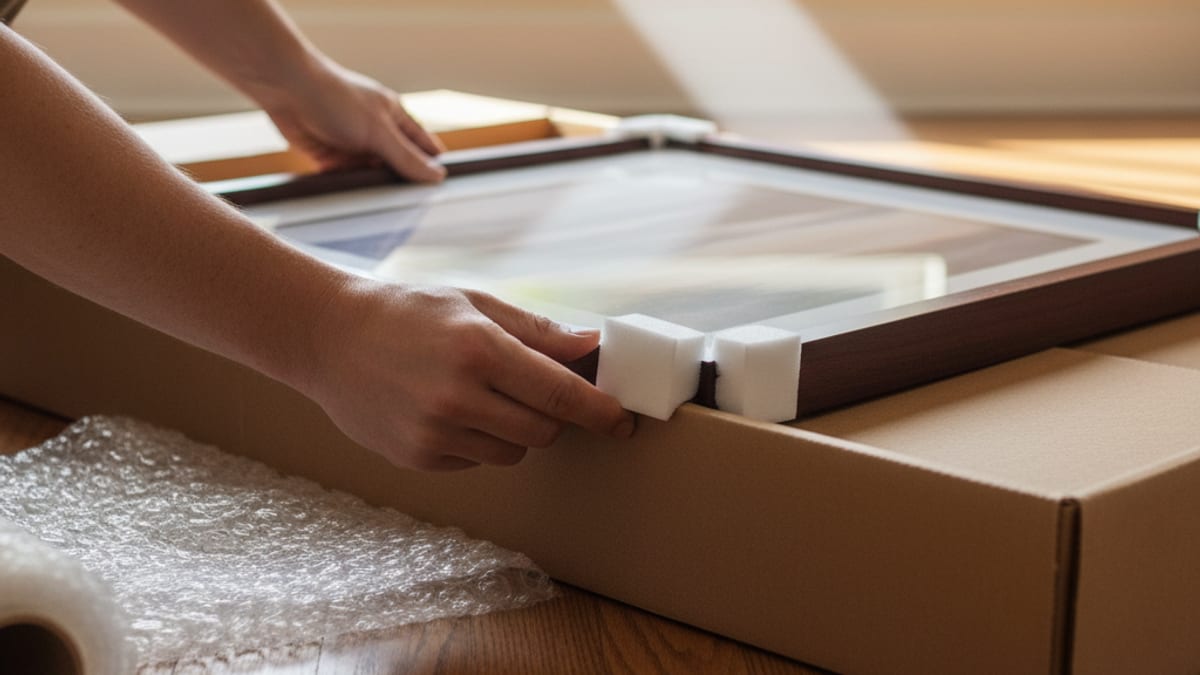
Picture frames travel best vertically with a piece of cardboard between each frame. Most San Diego moves, we use a dedicated picture-pack box or a flat mirror carton for these rather than the dish pack.
How do I label the box?
Three labels minimum: top, and two of the four sides. Each label says:
- FRAGILE
- THIS SIDE UP
- KITCHEN (or wherever it is going at destination)
Write with a thick black marker. Do not just put a small “fragile” sticker on top. Movers stack boxes by what is on top first; if “fragile” is only on one face, the dish-pack ends up on the bottom of a stack with a dresser on top.
For the kitchen pack, we also write a 2- to 3-word description on the side: “Dinner plates,” “Wine glasses,” “Mixing bowls.” Saves time at unpack when you are looking for the cereal bowls in a stack of similar boxes.
For reference, the FMCSA “Your Rights and Responsibilities When You Move” pamphlet at fmcsa.dot.gov/protect-your-move covers carrier liability on packed-by-owner versus packed-by-mover boxes. Carrier-packed boxes get the full Released Value or Full Value Protection coverage; PBO boxes are limited unless visible damage shows at delivery.
What if I do not want to pack?
Hire it out. Full pack on a typical San Diego kitchen runs $250 to $450 with a 2-mover packing crew, plus $40 to $80 in materials. The math: an experienced packer does the entire kitchen in 2 to 3 hours; a homeowner takes 6 to 10 hours. If your time is worth $25/hour, a pro pack pays for itself.
For the rest of the house and a full pack-and-move on the same day, see our packing services page or call (858) 925-5546.
If you have specialty items beyond the kitchen, our furniture moving team handles disassembly and pad-wrap. For pianos and gun safes, see piano specialty moving.
Frequently asked questions
Can I use bubble wrap instead of newsprint?
Yes for individual high-value items, no as the primary fill. Newsprint compresses and absorbs impact across an entire stack better than bubble wrap. Bubble wrap is reserved for electronics, screens, and glass that is genuinely irreplaceable.
Can I use towels and dishrags as fill?
For local moves, fine. For long-distance moves, no. Carrier liability is calculated by box weight; using towels as fill increases the weight without adding declared value. Pack dishrags in their own medium box and use real packing paper in the dish-packs.
How heavy should a dish-pack be when full?
55 to 65 pounds is the safe maximum. Heavier and the box bottom can fail. If a dish-pack feels significantly heavier than that, redistribute to a second box.
Should I pack the kitchen myself or have movers do it?
If you have time and the items are not heirloom-grade, DIY is fine following the method above. If the kitchen has wedding china, crystal, or 20 years of accumulated cookware, hiring it out usually pays for itself in saved time and zero breakage.
About the author
The Swift Move SD team. San Diego movers serving all 67 cities in San Diego County, with upfront written quotes across local, long-distance, and military PCS relocations. (858) 925-5546.